How I let coding agents run heavy jobs on throwaway cloud machines instead of the server they live on. A full browser test suite that took 62–82 minutes on a shared 8-core server now takes 5.5–7 minutes for about €0.14, and the server feels no load at all.
The problem
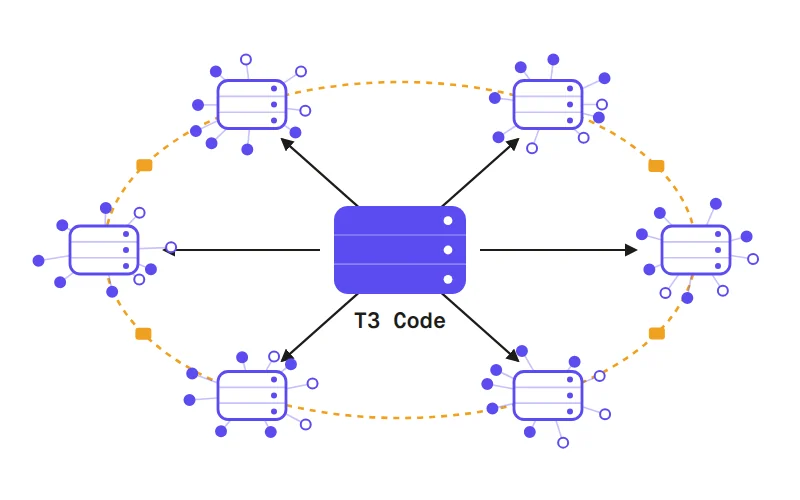
Several agents work on one server at the same time. Each of them sometimes needs something heavy: a Playwright suite with dozens of browsers, a big build, a video render. When three agents start that at once, load goes past 100, everything slows to a crawl and other services break.
Queueing heavy jobs (a "two at a time" gate) keeps the server alive but makes agents wait an hour for tests. The fix is to send that work somewhere else, but only for as long as the job runs.
What boxd.sh is
boxd.sh rents out disposable Linux VMs, driven from a CLI:
- AMD EPYC machines, up to 8 vCPU / 32 GB each, up to 100 machines per region (Frankfurt and New York).
- A machine starts from a saved snapshot in seconds, already holding your dependencies and browsers.
- Billing is per second and only for CPU and RAM that is actually busy: about €0.04 per busy vCPU-hour and €0.012 per active GB-hour. An idle machine costs almost nothing.
- Docker, Node, uv and passwordless sudo come preinstalled. You get SSH (
ssh <machine>.boxd) andboxd machine exec.
The model that works: create machines → fill them with work → collect results → delete them. Nothing lives there between jobs.
What it's good for
- Browser and end-to-end test suites. This is the main use, and where the numbers below come from.
- UI audits and screenshot runs across Chromium, Firefox and WebKit.
- Parallel builds, and CPU video renders (ffmpeg, Remotion) split across machines.
- Load tests: about 96 machines × 8 vCPU per region.
Not good for: anything that needs real secrets, anything that needs services on your private network, GPU work (there is no GPU), and long-running services.
Results
The same 197-file browser suite, same commit:
| where | wall time | cost |
|---|---|---|
| shared 8-core server | 82 min | – (but it blocks everyone else) |
| boxd, 4 machines × 10 lanes | 5 min 31 s | €0.14 |
Other full runs landed at 7 min and €0.12–0.15, with the four machines at 73–83% CPU.
How a run works
- One golden snapshot per project. Once, set up a machine with the runtime, pinned Playwright and its browsers, and the repo after
npm ci, then save it as a snapshot. It takes about 6 minutes and €0.02. Rebuild it when the lockfile changes a lot. - Ship code as a small git bundle. Only the commits since the snapshot, tracked files only: usually about 0.1 MB. No secrets ever go to the machines.
- Start a few machines from the snapshot, each with an auto-delete timer and a label for the run.
- Split the tests longest first over machines × lanes, using the last known durations.
- Run one test runner per lane. If tests use fixed ports (mock servers), give each lane its own network namespace so they don't collide.
- Pull the reports back and merge them into one, with cost and CPU per machine.
- Delete every machine, even when the script fails, then check the list and delete again.
How many lanes per machine
One 8 vCPU / 32 GB machine, the same 48 browser tests:
| lanes | tests/min | CPU | flakiness |
|---|---|---|---|
| 6 | 7.0 | 63% | lowest |
| 8 | 7.6 | 70% | low |
| 10 | 8.7 | 83% | acceptable |
| 12–16 | lower | 77–90% | tests slow down, more retries |
CPU is the limit, never RAM. Four machines × 10 lanes is my default for a full suite. Use 8 lanes when you are chasing flaky tests.
Rules I give the agents
- Every machine gets an auto-delete timer when it's created (
--delete-after 2h). It's the backstop if a script dies. - Delete the machine as soon as the job ends. No parked machines, no "maybe later".
- Keep CPU at 60% or more, or don't create the machine. Five machines at 85% is right; a hundred idle machines is wrong. One test per machine is the classic mistake: startup time dominates and the CPUs sit idle.
- No secrets on the machines. Tests use fake keys or mocks; anything that needs a real key runs at home.
- Report the € spent on every run, and set a ceiling per run so a runaway job needs a human OK.
Timings worth knowing
- Starting from a snapshot: the API answers in ~6 s, the machine is usable after ~36 s.
- Snapshot restores queue up at about one machine every two seconds: 10 machines are ready in ~20 s, 50 in ~1.5 min, 100 in ~3.3 min. Fewer, fuller machines beat a wide fan-out.
- Without a snapshot a machine is ready in ~3 s, but you install everything yourself.
- Disks are fast: ~900 MB/s writes, ~6.7 GB/s reads.
npm cifor a mid-size monorepo takes ~10 s.
Traps
- Never use stop/start. After
start, the machine never came back. Pause/resume works; delete and recreate is simpler. - The control plane is sometimes flaky. Calls can fail with "no machine" for a machine that is running, and
rmcan report success while the machine keeps going. Retry, then confirm withboxd list. - Snapshots are regional. A Frankfurt snapshot can't start a New York machine.
- The 100-machine limit is shared across your whole organization. Past it you only get "couldn't create that machine", with no word about a quota.
- The auto-delete timer also kills long jobs. If an agent itself runs on a boxd machine, it must push its work after every finished step, or the timer must be much longer than the job. Simpler: keep agents on your own server and send only the heavy commands to boxd.
What it costs
- A full browser suite at 4 × 10 lanes: about 2.1 vCPU-hours, €0.10–0.15.
- A golden snapshot build: about €0.02.
- Rerunning a few failing tests on one fresh machine: about €0.01.
- 231 mostly idle machines from scale-out tests: €0.036 in total.
Alternatives (not tested yet)
Everything above is specific to boxd.sh, the only one I've run in production. These services do the same job: disposable machines that agents create, use and throw away. I haven't tested them yet:
- boat: persistent Ubuntu VMs for agents with SSH, Docker, fast fork from snapshots and a virtual desktop. Billed per second, free when stopped; from $20/mo after a 7-day trial.
- Daytona: sandboxes for running AI-generated code, driven from SDKs (Python, TypeScript, Go and others). It advertises ~90 ms environment creation and stateful sandboxes.
The method carries over to any of them: a golden image, small bundles, fully packed machines, deletion right after the job, no secrets, and cost reported per run.
Hand it to your agent
Point your coding agent at this page, or at this site's MCP server (https://bulgakov.xyz/mcp, tool get_util, slug boxd-cloud-machines), and tell it to follow these rules whenever a job would overload your own machine.